Environmental Justice Advocates Rally in Trenton to Push for Real Clean Energy Policy

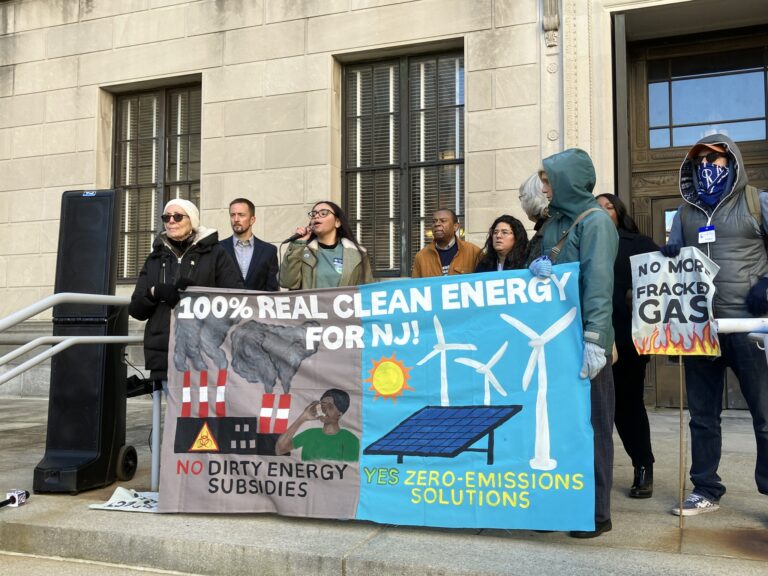
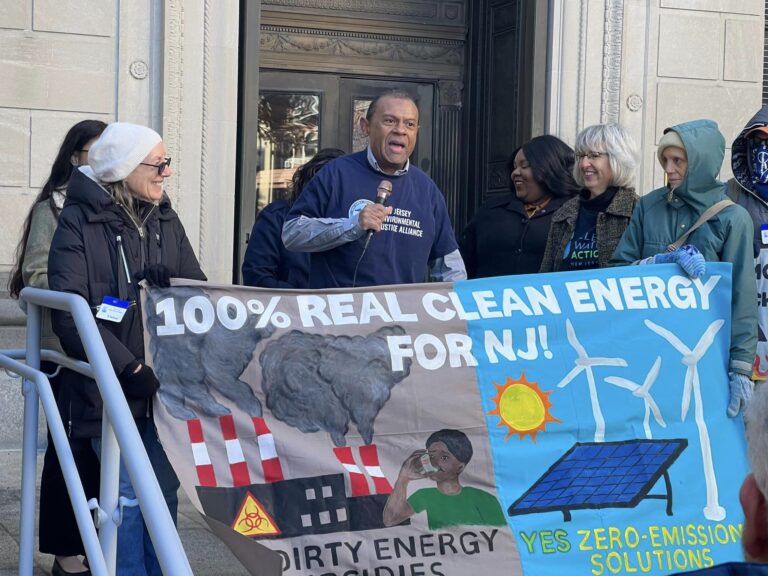
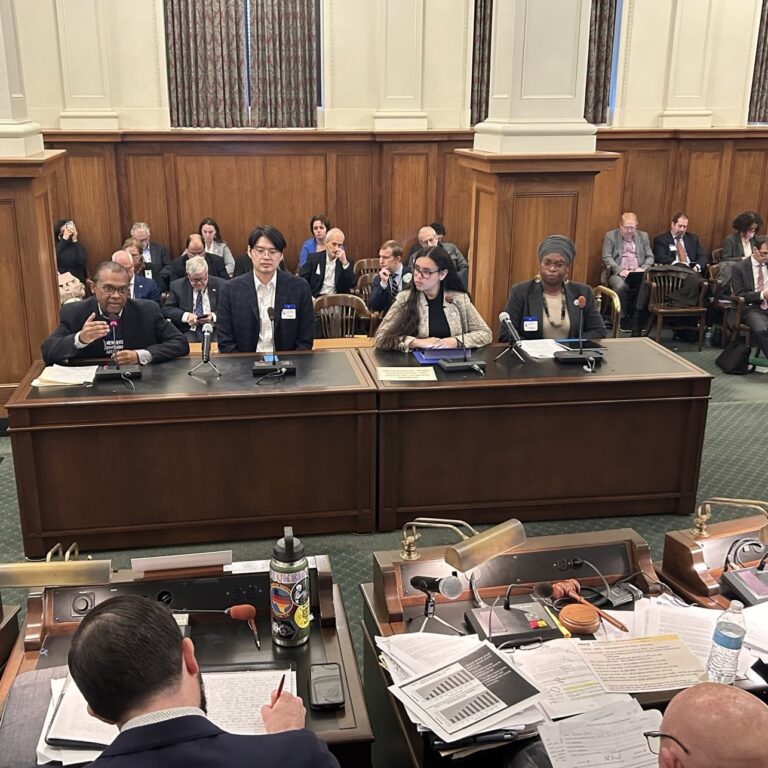
On November 20, 2023, the New Jersey Environmental Justice Alliance (NJEJA), alongside partner organizations including Ironbound Community Corporation and Clean Water Action, joined forces to rally and testify in Trenton. The focus of our advocacy was Senate Bill S2928, a crucial piece of legislation aimed at achieving 100 percent clean electricity by 2035. However, NJEJA urged for a critical amendment to the definition of “clean” energy, excluding sources that contribute to greenhouse gas emissions and toxic co-pollutants like NOx.

Trash incineration, hydrogen combustion, and flawed ‘carbon capture’ technologies are among the sources we sought to exclude from the clean energy definition. The rally and testimonies were integral to emphasize the importance of addressing harmful co-pollutants in climate change mitigation policy and recognizing the need to safeguard overburdened communities through robust legislation.

Melissa Miles, Brooke Helmick, Thomas Ikeda, and Dr. Nicky Sheets passionately testified on behalf of NJEJA, underscoring the urgency of prioritizing public health and environmental justice in clean energy policies. Dozens of environmental justice and climate activists participated in the rally, echoing the call for strong clean energy policies. The collective goal is to combat climate change, protect public health, and promote environmental justice. Activists also voiced their opposition to provisions in the bill that could impede the state’s transition to genuinely clean, non-polluting energy technologies, potentially tethering New Jersey to outdated and polluting fossil fuel practices.

“We want as close to zero emissions as possible,” stated Melissa Miles, Executive Director of the New Jersey Environmental Justice Alliance, during her testimony. She also criticized a provision in the bill that permits facilities to purchase clean-electricity credits to offset emissions in overburdened communities, emphasizing the need for comprehensive and immediate action to achieve meaningful environmental progress.

Press Release: New Jersey Releases Rules for Landmark Environmental Justice Law

For Immediate Release: Monday, June 6, 2022


For more information regarding this statement, please contact: 

JV Valladolid, jvalladolid@ironboundcc.org   cell:  862-588-4715


Statement from Ironbound Community Corporation, 

New Jersey Environmental Justice Alliance, Clean Water Action,

 and South Ward Environmental Alliance


New Jersey Releases Landmark Environmental Justice Rules


     Environmental Justice (EJ) communities throughout New Jersey are on the brink of change as the landmark Environmental Justice Bill S232 comes closer to being realized.  Today’s release of long awaited rules that accompany this landmark EJ Law is a critically  important milestone. 


The law and now proposed rules tackle the decades-long pattern of dumping polluting facilities in communities Of Color and low-income communities. Under these new rules, polluting facilities will be required to undergo a robust environmental justice review before being permitted in overburdened, i.e., environmental justice communities. These precedent-setting rules will arm New Jersey regulators with the right to deny further harmful pollution in these neighborhoods. Environmental justice communities will finally have a chance to have what many people take for granted – clean air and a safer environment in which to thrive. 


The just released rules would not have been possible without the tireless efforts of New Jersey environmental justice advocates and organizations, as well as State Senator Singleton, State Senator Ruiz, Assemblyman McKeon, Governor Murphy, NJ Department of Environmental Protection (NJEP) Commissioner LaTourette and staff that led to the passage of the law (S232) in the first place.


This rule reflects two years of continued hard work, expertise and community knowledge of EJ advocates who worked alongside the NJDEP staff to develop a strong set of rules that reflect the ambition, significance and promise of the landmark EJ law. We are eager to see these rules adopted as written as soon as possible and finally put to use in the communities that have been sacrificed for far too long. 


New Jersey Environmental Justice Alliance, Ironbound Community Corp. Environmental Justice, South Ward Environmental Alliance, and Clean Water Action will be making sure that communities understand and are engaged with the public hearings regarding the proposed regulations. Too often when a historic bill such as S232 is passed, people stop paying attention after the bill is signed. It is imperative that our communities stay engaged. Until the final rule adoption occurs later this year, we  urge the NJDEP to act in the spirit of the law and as we continue to fight our current battles for environmental justice in New Jersey, including: a fourth fracked gas power plant proposed by Passaic Valley Sewerage Commission, threat of a sludge facility proposed, and waste facility expansions in Camden. 


The draft rules require the NJDEP to evaluate the environmental and public health impacts of various polluting facilities on overburdened communities when reviewing specific types of permit applications. It lays out a process for assessing the burden that new facilities may pose to communities that are already overburdened and directs the state to deny those permits that contribute to the existing stressors in those census blocks. It requires additional reviews of existing facilities in overburdened communities that undergo a renewal or expansion process and can apply more stringent conditions to those existing facilities. It also offers a robust set of public participation processes for local input. 


“This is an important first step to ensuring that communities Of Color and communities with low-income in New Jersey have a chance to attain the clean environment  that other communities in the state enjoy.”

– Nicky Sheats, Ph.D., Esq, NJEJA Trustee


“The South Ward community of Newark just wants to breathe clean air and enjoy their quality of life free from additional toxic facilities impacting the health of the neighborhood.”

– Kim Gaddy, Environmental Justice Director, Clean Water Action


“We are excited about reaching this pivotal moment in the trajectory of the EJ law. Environmental Justice communities will be paying specific attention to what warrants a compelling public interest, what does it mean to avoid harming the community and provisions around community engagement.  We need to ensure that no industry green washes their way through EJ law.”

– Maria Lopez-Nunez, Ironbound Community Corp.


“These rules represent the hard work and diligence of EJ activists that have worked tirelessly alongside NJDEP to produce the strongest environmental justice law in the nation. Finally, there is a light at the end of this journey towards environmental justice for all.” 

– Ana Baptista, Ph.D., The New School University, NJEJA & ICC Trustee


“One of the most critical details of the Environmental Justice Law is the robust public process required of permitting facilities. For far too long some of the worst actors have lied or bought their way into the good graces of a few key people and claimed that their ‘back room’ deals were community engagement. Even now some communities expect polluting industries to operate in obscurity and without their input. That all ends with the implementation of the EJ Law.”

– Melissa Miles, Executive Director, New Jersey Environmental Justice Alliance (NJEJA)


-end –


Press Release: Coalition for Healthy Ports call for action on scrapyard fire at Eastern Metal Recycling Terminal at Port Newark

Coalition for Healthy Ports

Ironbound Community Corporation      

New Jersey Environmental Justice Alliance    

Clean Water Action    

South Ward Environmental Alliance

Immediate Release: Tuesday January 25, 2022

Contact:  Kim Gaddy, Clean Water Action and South Ward resident  973-914-2449

                 Maria Lopez-Nunez, Ironbound Community Corporation    201-978-6660    

                 Melissa Miles, New Jersey Environmental Justice Alliance  347-553-3338

TODAY, Newark – The Coalition for Healthy Ports (CHP)* issued a call for action regarding the scrap yard fire at Eastern Metal Recycling Terminal at Port Newark, the second large fire at this site since September 2021.

 Current policies, regulations and emergency response procedures leave communities and workers vulnerable to unknown chemical exposures and other harms of this facility and others like it during routine operations, only made worse during crisis management.

Community notification procedures and air monitoring systems are inadequate, leaving residents clueless as to what to do to protect themselves and their families. The only information residents are getting is from news reports. Agencies will have limited information to assess the situation, pollution impacts, and/or consider remedies to put in place in the future. 

It is also alarmingly unclear who has jurisdiction for permits, operations, emergency response and enforcement at Port Newark – Port Authority of NY&NJ (PANYNJ), NJ Department of Environmental Protection (NJDEP), Office of Emergency Management (OEM), Federal Occupational Safety and Health Administration (OSHA) for port, on-site and emergency responders just to name a few. The PANYNJ fire team deemed themselves ill equipped so the City of Newark Fire Department was called in to respond. Additionally, NJDEP’s oversight is currently limited, but we anticipate that the long awaited environment justice rules will include scrap yards – facilities that have long eluded regulatory controls and tools for community accountability.

The Coalition for Healthy Ports calls on the Governor and other responsible agencies to: 

  • take immediate action to protect residents and workers, properly and regularly inform them of developments related to the fire 
  • install emergency and permanent air/water monitors to assess pollution and health impacts
  • evaluate reasons for current fire and take immediate steps to prevent future fires
  • exercise enforcement powers where they may currently exist 
  • formally propose and adopt cumulative impact regulations as soon as possible, including scrap yards and other previously un/underregulated facilities of concern
  • resolve chronic jurisdictional issues and enforcement powers at the port 
  • hold a community meeting to both inform and receive public input on their concerns and demands for action

Below are quotes from impacted community leaders and Coalition for Healthy Ports members:

“ We often have to worry not just about fires but what is burning in those fires. No one should go to bed with nausea or headaches from the smells outside but our residents know the feeling all too well. This fire joins a long list of situations that remind us how close we are to potential catastrophe in our communities because of the concentration of toxic reactive chemicals. We need more than lip service, we need real protection. It is exhausting to keep asking for protection from our state but there are decades of historic injustice that must be addressed.” Maria Lopez-Nuñez, Deputy Director, Organizing and Advocacy, Ironbound Community Corporation

“Longshoreman and Newark residents deserve to be protected from fires at Port Newark.  Our health must be a priority of Gov. Murphy and the PANYNJ. As a South Ward resident living in a Port community, we demand mandatory air monitoring and environmental enforcement at the Port today.” Kim Gaddy, Executive Director, South Ward Environmental Alliance and New Jersey Environmental Justice Director, Clean Water Action

“Leadership at the Port of Newark has consistently denied their responsibility for air pollution beyond their fence line. This is a clear incidence of serious impacts as far away as New York City. We need fence line air monitoring and community accountability from the Port and its tenants.” Melissa Miles, Executive Director,  New Jersey Environmental Justice Alliance

“This fire is a reminder of the threats that port related waste facilities pose to community and worker health. In times of emergency, we must have clear lines of communication and a coordinated response to protect people. We call on state and local agencies together with the PANYNJ to ensure effective monitoring and enforcement to prevent future fires.” Ana Baptista, P.h.D. Co-Director, Tishman Environment & Design Center, The New School University and Coalition for Healthy Ports Member

“The frequency of chemical fires occurring in New Jersey is on the rise – sounding the alarm for immediate action. The state must step up enforcement of existing laws and adopt long awaited cumulative impact protections including strict oversight of polluting facilities and scrap yards in already grossly overburdened communities and port region. Anything less than this is an environmental and public health injustice to residents and workers.” Amy  Goldsmith, NJ State Director, Clean Water Action and Steering Committee Member, Coalition for Healthy Ports

“The New Jersey Governor’s Office, New Jersey Department of Environmental Protection and all relevant governmental agencies need to work together to address this alarming fire and to prevent this type of incident from happening again in the future.” Nicky Sheats, Esq., Ph.D., Director, Center for the Urban Environment, John S. Watson Institute for Urban Policy and Research at Kean University, and New Jersey Environmental Justice Alliance Member

###

* Coalition for Healthy Ports (CHP) is a bi-state alliance founded in 2007 by environmental and environmental justice activists, truck drivers, faith leaders, labor unions, and community advocates fighting for zero emissions, clean air, good jobs, healthy communities, environmental and economic justice at the Ports of New York and New Jersey and throughout the logistics industry. Particular emphasis is given to port-adjacent communities that are disproportionately overburdened by port pollution and operations. www.coalitionforhealthyports.org
Comments on BPU Charging Infrastructure Straw

Comments on: In The Matter Of Medium And Heavy Duty Electric Vehicle Charging Ecosystem, New Jersey Electric Vehicles Infrastructure Ecosystem 2021 – Medium And heavy Duty Straw Proposal

One of the most important policy recommendations that has been supported by a significant segment of the environmental justice (EJ) advocacy community is that climate change mitigation policy, in addition to fighting climate change, should be used to reduce the disproportionate amount of pollution often found in EJ communities.

In the power generation sector the EJ advocacy community has indicated this means, at least partly, that electricity generating plants located in EJ residential communities should be required to reduce emissions, no matter what type of climate change mitigation program applies to the plants. This policy would guarantee that climate change mitigation policy would deliver critical reductions in locally harmful greenhouse gas co-pollutants to vulnerable and overburdened EJ communities. These reductions would improve the health of residents living in communities affected by plant emissions. The New Jersey EJ Alliance (NJEJA), has called this policy “mandatory emissions reductions for EJ communities through climate change mitigation policy”.

NJEJA is a statewide organization that focuses solely on EJ issues and advocates for policies that will improve the quality of life of low-income communities and communities Of Color, i.e. EJ communities, in New Jersey and across the nation. It is important to note that NJEJA has strongly advocated for the adoption of the mandatory emissions reductions for EJ communities through climate change mitigation policy and opposed New Jersey’s entrance into the Regional Greenhouse Gas Initiative and Transportation and Climate Initiative, in part because they do not guarantee such reductions. A comparable type of mandatory emissions reductions policy that directly and unequivocally improves the health of EJ communities is needed for the transportation sector. The New Jersey Board of Public Utilities’ (NJBPU) Notice, In The Matter Of Medium And Heavy Duty Electric Vehicle Charging Ecosystem, New Jersey Electric Vehicles Infrastructure Ecosystem 2021 – Medium And heavy Duty Straw Proposal (hereinafter referred to as Straw Proposal), provides New Jersey with an opportunity to discuss and make progress on this type of important policy. NJEJA is submitting the following comments in an effort to further that discussion.