

A Quick Guide to Carbon Capture and Storage (CCS)

As carbon capture and storage (CCS) continues to be pushed as a solution to climate change by both private and public investment, NJEJA has developed this fact sheet to explain CCS, the risks to our communities, and why carbon capture is simply going to prolong our reliance on fossil fuels.

For questions, please reach out to Brooke Helmick, Director of Policy at brooke@njeja.org.

Environmental Justice Concerns with Carbon Capture and Hydrogen Co-Firing in the Power Sector

Read the latest report on Environmental Justice Concerns with Carbon Capture and Hydrogen Co-Firing in the Power Sector, prepared in partnership with the New School Tishman Environment and Design Center, Center for the Urban Environment of the John S. Watson Institute for Urban Policy and Research at Kean University, and the Center for Earth, Energy, and Democracy.

For questions, please reach out to Brooke Helmick, Director of Policy at brooke@njeja.org.
A Quick Guide to Hydrogen Production and Hydrogen Co-Firing

As the country sees a proliferation of hydrogen fuel projects through both private and public investment, NJEJA has developed this fact sheet to explain hydrogen fuel production, the risks to our communities, and how to understand the “colors” for each type of hydrogen.

For questions, please reach out to Brooke Helmick, Director of Policy at brooke@njeja.org.
Cumulative Impacts Primer

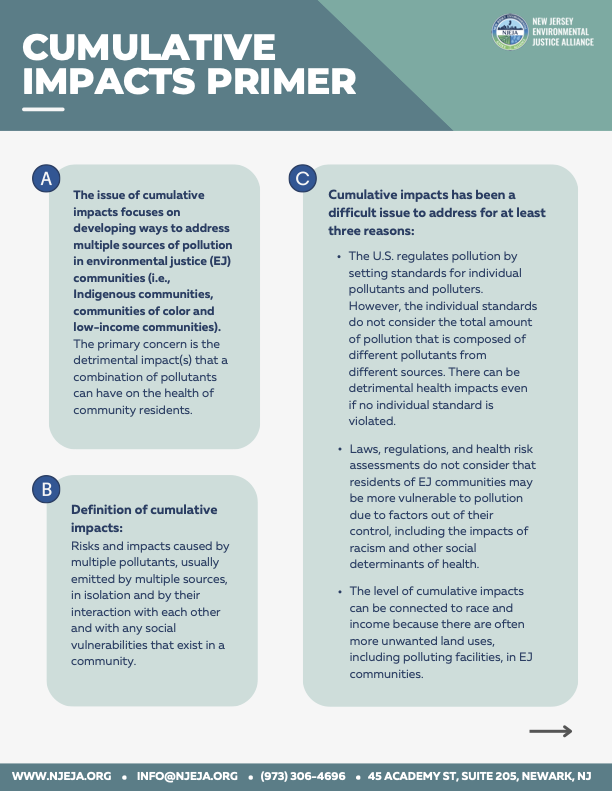
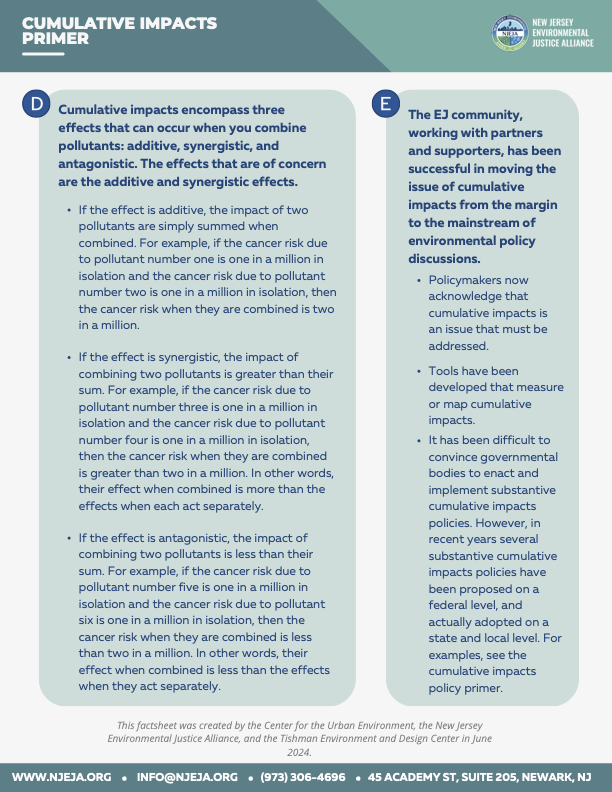
Cumulative impacts can be defined as the impacts caused by multiple pollutants, often emitted by multiple sources of pollution, and their interaction with each other and with any social vulnerabilities that exist in a community. The term is also frequently used to refer to the risks associated with the pollutants and the aforementioned interactions.

Click below to download and/or print this document.