In a time when climate progress is under attack at the federal level, state leadership is more important now than ever. Many states across the nation are taking bold steps to accelerate their clean transportation goals. For example, programs in California include procurement policies like the Innovative Clean Transit Regulation and the Clean Miles Standard, while Colorado, New York and New Mexico maintain a diversity of electric vehicle (EV) incentive and charging infrastructure programs. This also includes California Governor Newsom’s EO N-27-25, which directs state agencies to submit new policy recommendations to make progress on clean transportation without new federal approvals, as well as to provide state incentives for OEM manufacturers that continue to comply with the original Clean Cars standards.
The transportation sector is New Jersey’s largest source of climate-harming emissions and localized air pollution. Continuing to push for innovative ZEV policies is therefore paramount to achieving New Jersey’s climate targets and cleaning up our air quality. Embracing these policies will reduce harmful emissions and improve public health while fostering economic growth through green jobs in manufacturing, infrastructure development, and technological innovation.
We are proud to join @WEACT4EJ and over 90 organizations calling on Congress to increase funding levels for the U.S. Environmental Protection Agency (EPA) including environmental justice programs, in fiscal year 2026. After catastrophic and unlawful environmental justice funding cuts from the current administration, this call from organizations across the country emphasizes the need to protect all of our access to clean air, water, and land.
In May, we joined our partners at the Equitable and Justice National Climate Platform and 65 organizations across the country in a letter urging the House of Representatives and the House Committee on Energy and Commerce to protect funding for environmental justice programs like the Clean Ports program and the Climate Pollution Reduction Grants program. These funds are crucial for EJ communities, as they help reduce local air pollution and protect public health.
Programs that improve public health such as Air Pollution Monitoring for schools, the Environmental and Climate Justice Block Grants program, Clean Ports Program and the Climate Pollution Reduction Grants program are not only vital to protecting vulnerable communities from a legacy of greater hazard exposure, they are also needed investments to create opportunity. The grant funds aren’t just a dollar figure. These are real losses—for residents breathing polluted air, for communities threatened by climate risks. It is extremely important that members of Congress oppose any provisions in the budget reconciliation bill that cancel public health protections. We must protect environmental justice programs that are crucial to the health and well being of the most vulnerable communities.
Environmental justice organizations across the country came together to support federal protections of LIHEAP (Low-Income Home Energy Assistance Program) which brings not only economic relief to families across the country, but yields public health benefit as well.
This letter – addressed to the House and Senate Subcommittees on Labor, Health and Human Services, Education, and Related Agencies – calls on lawmakers to fully fund LIHEAP at $5.1 billion, and to include supplemental emergency funding of $2 billion. Additionally, the letter requests assurances that the LIHEAP office will be fully staffed moving forward after news broken that HHS illegally fired LIHEAP staff.
NJ organizations from across the state and advocacy spaces joined together to call on Governor Murphy’s office to continue their support for the implementation of the Advanced Clean Trucks rules and regulations. The rules would support efforts to curb local air pollution levels by incrementally increasing the number of electric vehicles on the road, thereby decreasing levels of diesel exhaust and related air pollution. This work has co-benefits of supporting climate mitigation policies as well as public health goals.
To learn more about the Advanced Clean Truck rules, read our blog post Debunking ACT Myths. For questions, please reach out to us at info@njeja.org.
In continuation of reviewing and redoing the 2019 New Jersey Energy Master Plan, the NJ Board of Public Utilities (BPU) solicited comments on their analysis and work. NJEJA offered our support and guidance based on our work, experience, and relationships with community partners to articulate support for increased usage of renewable energy, opposition to carbon capture/hydrogen technologies, and continued prioritization of low-income and environmental justice communities.
For questions, please reach out to us at info@njeja.org
When discussing emissions, the focus often centers on power plants, while the environmental impacts of goods movement (i.e., trucks, trains, ships, and other forms of transportation) are frequently overlooked.In 2020 alone, New Jersey’s Medium- and Heavy-Duty Vehicles (MHDV) fleet neared 423,000 vehicles and was responsible for producing approximately 7.6 million metric tons of greenhouse gases, which are direct contributors to climate change. Mid-sized vehicles include utility and delivery vehicles, motorhomes, ambulances, and small school buses, while heavy-duty vehicles include dump trucks, tractor-trailers, and construction vehicles, among others. Collectively, MDHVs account for about 20% of greenhouse gas emissions from road fleets.
In addition to their role in the climate crisis, medium and heavy-duty vehicles are major contributors to poor air quality, producing dangerous co-pollutant emissions such as volatile organic compounds (VOCs), particulate matter (PM), and sulfur oxides (SOx). These emissions range in color and weight, but have been demonstrated to have severe health impacts. They disproportionately affect environmental justice communities — particularly low-income communities, and communities Of Color — due to their proximity to transportation hubs and goods movement infrastructure. As a result, EJ communities bear the brunt of our easy access to goods via a myriad of negative health impacts, including higher rates of asthma, heart disease, and respiratory infections, as well as adverse birth outcomes such as low birth weight, premature birth, and neurodevelopmental difficulties. These negative health impacts produce both emotional stress and physical tolls to communities, while also imposing significant economic costs.
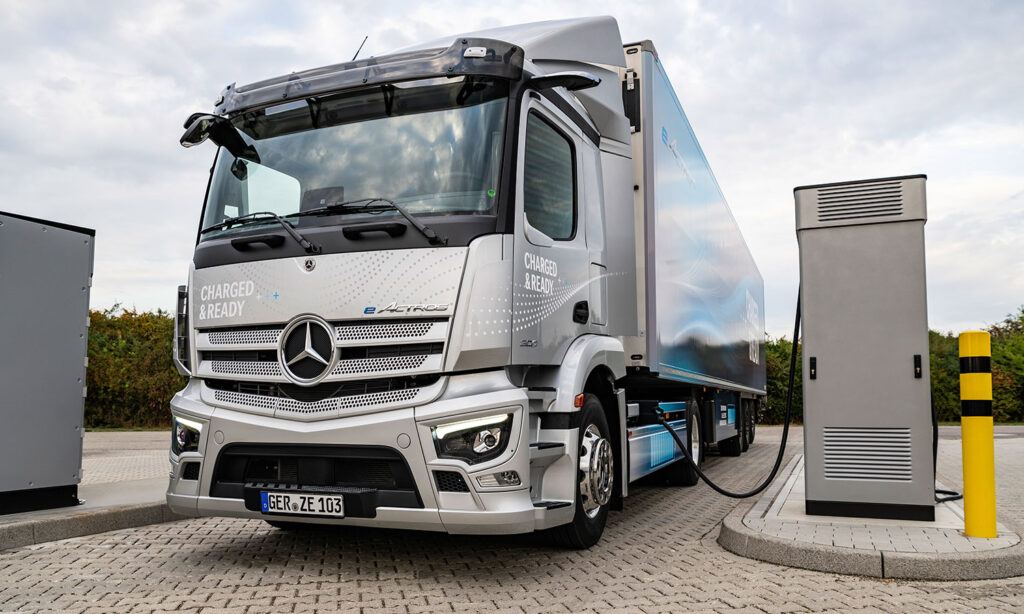
Recognizing the need to address these problems, the New Jersey legislative body adopted the Advanced Clean Trucks (ACT) Rule, modeled after a similar California rule. ACT aims to facilitate a transition to zero-emission medium and heavy-duty (MHDV) trucks from 2025-2035 by requiring manufacturers to sell these trucks at an increasing percentage of their yearly sales. By enacting this rule, New Jersey jas joined a coalition of 11 other states nationwide working to reduce emissions from MHD vehicles, reducing air pollution, and advancing environmental justice through the adoption of electrified vehicles.
In New Jersey, implementation of the ACT Rule will follow a gradual, upward trajectory over ten years. The regulation primarily impacts two main groups: vehicle manufacturers and dealers. Manufacturers comply with the ACT Rule through a credit and deficit structure. Under this framework, each sale of a fossil-fuel-powered vehicle incurs a deficit, while sales of zero-emission vehicles (ZEVs) or near-zero-emission vehicles (NZEVs) generate credits. The value of each credit and deficit is weighed according to the vehicle’s size and classification, with larger trucks incurring more credits/deficits and smaller trucks incurring fewer. By the end of the year, manufacturers reach compliance when the total number of credits retired equals the total deficits. Dealers, then, are responsible for selling and distributing the vehicles that manufacturers produce.
The chart below demonstrates the progression of zero-emission vehicles (ZEV) that manufacturers must follow:
Year
Class 2b-3
Class 4-8
Class 7-8
2025
7%
11%
7%
2026
10%
13%
10%
2027
15%
20%
15%
2028
20%
30%
20%
2029
25%
40%
25%
2030
30%
50%
30%
2031
35%
55%
35%
2032
40%
60%
40%
2033
45%
65%
40%
2034
50%
70%
40%
2035 & beyond
55%
75%
40%
Sales Percentage Schedule (2025-2035)
The successful implementation of ACT in other states has led to a rapid shift in industry behavior, undeniably lowering tailpipe emissions and improving air quality in these states. One such example comes from California, where the state body facilitating ACT implementation noted that ZEV sales more than doubled from 2022-2023.
Despite the clear and dire need to address the effects of diesel-powered vehicles — including their physical, communal, environmental, and climate impacts — and the demonstrated success of ACT in other states, there has been significant industry opposition to this rule. Additionally, proposed legislation in the New Jersey Assembly threatens to delay implementation of ACT until 2027.
While we acknowledge that stakeholders may have valid concerns, many of these issues were also raised in California and other ACT states and were successfully addressed in tandem with implementation. Below are a few misconceptions about ACT that NJEJA hopes to dispel.
CLAIM: ACT bans sales of diesel or combustion-powered vehicles after 2025.
FALSE: ACT only mandates the sales of zero-emission vehicles at an increased percentage every year. This does not preclude manufacturers from selling other types of vehicles, but instead requires that they comply with target ZEV sales every year.
CLAIN: ACT requires vehicle dealers to buy ZEVs and NZEVs.
FALSE: The responsibility of compliance with ACT lies with manufacturers. Any manufacturer’s attempts to shift compliance to dealers by “rationing”, or refusing to sell diesel trucks unless the dealer buys a certain number of ZEVs or NZEVs, are not mandated or authorized by ACT. This tactic allows manufacturers to convince dealers that ACT is not in their best interest. The reality is that ACT does not force dealers to buy cars they do not need, and it provides manufacturers ample flexibility to build a diverse fleet of diesel vs electric vehicles. This challenge can be surmounted through legislative and regulatory oversight at the state level, but should not bar New Jersey from moving forward with ACT implementation.
CLAIM: There is no market for zero-emission medium and heavy-duty trucks.
FALSE: According to the Zero Emission Technology Inventory, there are over 200 commercially available models of ZEVs for medium and heavy duty trucks in the United States. California – where the Advanced Clean Trucks rule was adopted in 2021 – saw sales of zero-emission medium and heavy-duty trucks double from 2022 to 2023, demonstrating that the market for ZEVs will continue to grow as demand for these vehicles increases.
CLAIM: Zero-emission medium and heavy-duty trucks are more expensive.
FALSE: While upfront costs for some ZEVs are currently higher than their diesel counterpart, maintenance costs are reportedly 40-70% lower, and lifetime costs of ZEVs are projected to be lower than operating diesel trucks as well. This results in lower costs overall: both an environmental and economic benefit.
CLAIM: New Jersey does not have suitable charging infrastructure for electric vehicles to comply with ACT.
FALSE: There are ZEVs on the market that do not require public charging stations, as charging at depots where goods are loaded or unloaded can cover most of these vehicles’ travel range. Additionally, a critical aspect of ACT is that manufacturers can trade credits to be in compliance with the rule. This means that if a fleet of buses can be electrified while other types of heavy-duty vehicles cannot be, then a manufacturer that has an excess of credits due to their electrified bus fleet can sell those credits to other manufacturers until later years when those vehicles can be sold in compliance with ACT.
CLAIM: Delaying until 2027 will give the trucking industry enough time to comply with ACT.
PARTLY TRUE, PARTLY FALSE: The ACT Rule does not necessitate that all EV charging infrastructure be ready and built, or that all fleets be converted to ZEVs in 2025. Instead, it intentionally starts with small percentages to ease manufacturers, private interests, and public stakeholders into compliance. This leaves space for investment in public charging infrastructure, including $250 million from the IRA for New Jersey, and increases the innovation and scalability of ZEVs, which in turn, would result in the decrease of initial and overall costs over time. While delaying implementation would technically grant more time to the industry, it also means that the starting compliance thresholds are higher in 2027 since a delay doesn’t push back the whole timing. Waiting two years makes it more difficult to catalyze this process, especially without the safety net of gradual phase-in and early preparation that time undoubtedly adds.
For the health of our communities, the success of ACT’s implementation, and the growth of the ZEV economy, it is essential to continue on the path started in the initial rule-making and adhere to the original implementation timeline. Diesel emissions not only endanger the health and well-being of surrounding communities but also pose significant risks to those within the industry itself, including truck drivers and warehouse workers who experience prolonged exposure to air pollutants. By advancing the transition to zero-emission vehicles, we can significantly reduce health impacts and improve the well-being and quality of life for workers in the industry. Surely there will be challenges as implementation of a new program is never a simple process, but it is only through cross-sector collaboration (including environmental and social justice groups, community members, workers in the trucking industry, other industry stakeholders, health experts, and elected officials) that we can holistically address these concerns without delaying ACT implementation. Only then can we be sure we are taking the necessary steps towards decreasing local air pollution and greenhouse gases through technology that has been tested and proven to work effectively and at scale.
As part of New Jersey’s efforts to curb the urban heat island effect and support disproportionately polluted communities across the state, the NJ Board of Public Utilities put out a call for comments on their Urban Heat Island mitigation program. NJEJA offered our guidance and expertise in this area to support the BPU in fulfilling their program goals and supporting overburdened communities.
For questions, please reach out to us at info@njeja.org
Recently, the Trump Administration put out a rule that would remove important regulations in the National Environmental Policy Act (NEPA) which protects environmental justice communities. If implemented, the new rules would expedite permitting and prioritize efficiency over thorough analysis of the cumulative impacts and risk to EJ communities.
NJEJA joined our partners at the Moving Forward Network, NRDC, and the Environmental Justice Health Alliance to express our opposition to these new rules as they will likely lead to further disproportionate impact on environmental justice communities across the country.
For questions and additional support on NJ EJ Law engagement, please reach out to us at info@njeja.org
NJEJA, along with signed partners, respectfully submit these comments under the New Jersey EJ Law to the Reworld Union Facility in Rahway, New Jersey regarding their Title V Operating Permit.
For questions and additional support on NJ EJ Law engagement, please reach out to us at info@njeja.org