Questions at the MACH2 April 10 Listening Session

The New Jersey Environmental Justice Alliance has raised significant questions to the MACH2 engagement team both via email and at the April 10 MACH2 Listening Session. During the April 10 Listening Session, our team sent in questions via chat. Due to the number of participants, only one person from NJEJA was put onto the speaking list which was created and shared by OCED prior to the event.

We raise these questions out of deep concern and love for our community. The life cycle of hydrogen production is not only costly and economically inviable, but has not been proven safe for our communities. In fact, in many instances, demonstration tests for hydrogen projects have proved to be dangerous, unsustainable, and not effective projects. Furthermore, regardless of whether or not the hydrogen produced is “green” (I.e. hydrogen theoretically created from entirely renewable technology), it poses the same risks during transportation, storage, and end use as hydrogen created from fossil fuels.

In an effort to increase transparency and get these questions answered, please see the concerns that NJEJA has raised to the MACH2 team regarding the structure, function, intention, and infrastructural development of the MACH2 project.

Questions for the MACH2 Community Engagement Team

The New Jersey Environmental Justice Alliance has raised significant questions to the MACH2 engagement team both via email and at the April 10 MACH2 Listening Session. We are deeply concerned about the level of community engagement and the claim of community benefits agreements without significant investment, input, and consent from the communities who will host this infrastructure.

It is imperative that organizers for the hub consider the input of host communities, which are primary Environmental Justice communities and frontline communities who are already significant burdened by pollution and negative air quality. We call upon OCED and hub organizers to honor the community’s right to exercise free, prior and informed consent as well as their right to refuse, by providing transparent and robust information.

In an effort to increase transparency and get these questions answered, please see the concerns that NJEJA has raised to the MACH Community Engagement team regarding the logistical development of this process.

EJ Law Meeting: Linden Union County

Join this meeting as part of the Title V Operating Permit renewal application process for the Safety-Kleen Systems, Inc. facility in Linden. As part of this process, this facility has submitted an Environmental Impact Statement. Read the statement here.

Attend the hearing to learn more information about local impacts, ask questions, and make a public comment. Join this hearing via this link here with access code 2431 053 0733. 

The public comment period will close on Wednesday, June 25.

For questions and comments, please contact Brooke Helmick, Director of Policy at brooke@njeja.org.

Press Release: EJ Community Members Say: EPA Rules Must Incorporate Cumulative Impacts Analysis and Discontinue Reliance on CCS

FOR IMMEDIATE RELEASE: April 26, 2024

Press Contacts

NJ Environmental Justice Alliance: Melissa Miles | melissa@njeja.org 

Center for the Urban Environment of the Watson Institute for Urban Policy & Research: Dr. Nicky Sheats, Esq. | nsheats@kean.edu

Tishman Environment and Design Center: Dr. Ana Isabel Baptista | baptista@newschool.edu  

Ironbound Community Corp.: Maria Lopez-Nunez | mlopeznunez@ironboundcc.org 


EJ Community Members Say:

EPA Rules Must Incorporate Cumulative Impacts Analysis and Discontinue Reliance on CCS


Washington D.C.On April 25, the EPA announced a suite of four standards on toxic air pollution, water pollution, land contamination, and GHG (greenhouse gas) emissions from fossil fuel burning power plants. Key among these is the final rule for existing coal-fired and new natural gas-fired power plants. 


We recognize the important steps the EPA has taken in removing hydrogen co-firing from consideration as a BSER (Best System of Emissions Reduction) and understand the importance in a delayed ruling on reducing GHG emissions from existing natural gas plants in order to consider the best approach and to address environmental justice concerns. 

In order to best address the risks of climate change and local air pollution as well as protect frontline Environmental Justice communities, the EPA should incorporate a cumulative impacts and MER (mandatory emissions reduction) approach. 

We would also call upon the EPA to continue to strengthen its rules and ensure that future rules do not include hydrogen co-firing or CCS/CCUS as a BSER. We urge the EPA to discontinue its reliance on and promotion of CCS as a technological solution to climate change mitigation. CCS is an unproven and high-risk approach to reducing GHG emissions, and fails to address co-pollutant emissions from power plants in a meaningful and holistic way. 

###

“The EPA Power Plant Rule update resulted from decades of organizing and advocacy and years of partnerships between the EPA and Environmental Justice communities. The EPA is modeling some of the best practices around the engagement of impacted communities, and these updated rules are a win for us all. At the same time, we acknowledge the parts of the rules flagged by communities as non-starters, namely the use of carbon capture, utilization and storage in EJ communities. The implicit inclusion of this dangerous technology was a loss for us all. However, we maintain hope that the next update will incorporate cumulative impacts and a mandatory emissions reduction approach to regulating existing power plants.”

Melissa Miles, 

Executive Director, New Jersey Environmental Justice Alliance


“I congratulate EPA on the decision to remove hydrogen co-firing from the power plant rule. However, cumulative impacts and mandatory emissions reductions policies should be incorporated into the rule to protect environmental justice communities in general, and especially as a safeguard for the potential harms of carbon capture technology, which unfortunately remains in the rule. These protective policies should also be incorporated into the existing gas plants portion of the rule.”

Dr. Nicky Sheats, Esq., 

Director, Center for the Urban Environment, John S. Watson Institute for Urban Policy and Research at Kean University 

President of the Board and member of the New Jersey Environmental Justice Alliance


“We want to urge the USEPA to prioritize the health and well-being of environmental justice communities in the implementation of these rules. We look forward to seeing mandatory emissions reductions and approaches to reducing cumulative impacts embedded in the regulations now being developed for existing natural gas plants.”

Dr. Ana Isabel Baptista, 

Co-Director Tishman Environment & Design Center

NJEJA Board Member 


“EPA has to show progress on cumulative impacts and mandatory emissions reductions if we are to believe that this administration is not just all talk regarding the welfare of the most vulnerable communities. These concepts must be embedded into existing and future regulation to safeguard our communities from bad local actors.”


Maria Lopez-Nunez,

Deputy Director, Organizing and Advocacy Ironbound Community Corporation


For questions regarding this statement, please contact Brooke Helmick, NJEJA Director of Policy at brooke@njeja.org

The New Jersey Environmental Justice Alliance is an alliance of New Jersey-based organizations and individuals working together to identify, prevent, and reduce and/or eliminate environmental injustices that exist in communities of color and low-income communities. NJEJA will support community efforts to remediate and rebuild impacted neighborhoods, using the community’s vision of improvement, through education, advocacy, the review and promulgation of public policies, training, and through organizing and technical assistance.

The Center for the Urban Environment (CUE) strives to protect communities Of Color and low-income communities from disproportionately high amounts of pollution by addressing environmental justice (EJ) issues on the local, state and national levels. 

The Tishman Environment and Design Center at The New School is a collaborative community of practice that leverages research, policy, and design in accordance with the Jemez Principles for Democratic Organizing. Our Center brings together research and action to tackle the root causes of climate and environmental injustice and commit to changing higher education practices within and beyond The New School. 

The Ironbound Community Cooperation upholds and builds upon the principles of “Justice and Equality for All.” We strive to practice and build equity, work towards a Just Transition, and organize community on the basis of the Jemez Principles. We envision a safe, healthy, just, and nurturing Ironbound; a welcoming and fully inclusive community that supports equal and accessible opportunity and the quest for a better life. For us, revitalization means uplifting both people and place. Therefore, we aim to lead the transformation of Ironbound into a neighborhood where anyone might choose to live and current residents can remain in their homes and their community without fear of being displaced.
March for Clean Air

Join us in attending the March for Clean Air, hosted by the Ironbound Community Corporation and co-sponsored by the New Jersey Environmental Justice Alliance. Attend the rally and march in our contingent as we oppose the Passaic Valley Sewerage Commission’s harmful plan to construct a fourth power plant in Newark and fight for our human right to breathe clean air, irrespective of race, income, or zipcode. 

What: March for Clean Air

Where: Down Bottom Farms, 371-395 Ferry St, Newark, NJ 07105

When: Saturday April 20th,12-2pm

Registration Link: bit.ly/CleanAirNow

For transportation accommodations, please contact Chloe Desir at CDesir@ironboundcc.org. 

For questions regarding NJEJA’s participation and event logistics, please contact Brooke Helmick at brooke@njeja.org

Press Release: Protect EJ Communities While Mitigating Climate Change

NJEJA logo ICC logo

FOR IMMEDIATE RELEASE: March 15, 2024

Press Contacts

NJ Environmental Justice Alliance: Brooke Helmick | brooke@njeja.org

Center for the Urban Environment: Nicky Sheats, PhD, Esq. | nsheats@kean.edu 

Ironbound Community Corp.: Maria Lopez-Nunez | mlopeznunez@ironboundcc.org 


Environmental Justice Communities Say: 

Protect EJ Communities While Mitigating Climate Change 


Trenton – On March 14, the Senate Energy and Environment Committee both strengthened and voted in favor (3-2) of a Clean Energy Standard (S237/A1480). The EJ community has been actively involved in calling for a nation-leading definition of clean energy and climate change mitigation policy that reduces locally harmful GHG co-pollutants in overburdened Environmental Justice communities, and does not allow for potential loopholes or false solutions. 


We celebrate the passage of this strong definition, and the fact that this bill makes New Jersey a leader in ensuring states prioritize the procurement of clean energy. However, we also recognize that this bill has a long way to go before it can be enacted into law. This moment cannot be the end of the conversation, and we will continue to call for new language and provisions that actively protect EJ communities while creating new jobs and a cleaner environment. 


We call upon legislators to continue fine-tuning this bill by ensuring that the legislation: 

  • Reduces toxic air pollution in EJ communities by removing “net emissions” calculations;
  • Creates a strong standard for “de minimis” levels of pollution that are as close to zero as possible; and 
  • Prevents polluting facilities such as incinerators from receiving ratepayer subsidies when they violate air permits. 


“This moment represents a turning point for the state and the country. Including co-pollutants in the definition makes New Jersey a leader in protecting frontline communities. There is more work to be done to make sure that the bill is as protective of EJ communities as possible, but we take this moment to celebrate and honor the many advocates who have worked tirelessly to protect public health, call for climate change mitigation, and ensure that EJ communities are not left behind in the energy transition.” 

Melissa Miles

Executive Director 

New Jersey Environmental Justice Alliance 


“It’s so refreshing to see a holistic and necessary approach to defining clean energy. If we do not include co-pollutants, we stand to repeat the mistakes of the past where we sacrifice local communities for the so-called “greater good.” Today is an important step in leading the country towards a future that deals with both public health and climate change.” 

Maria Lopez-Nuñez

Deputy Director, Organizing and Advocacy

Ironbound Community Corportation


“Incorporating GHG co-pollutant reductions into a clean energy standard is the type of action the environmental justice community has been strongly recommending for many years. It will help protect communities near energy infrastructure from locally harmful co-pollutant emissions while at the same time fighting climate change.”

Nicky Sheats, Ph.D., Esq.

Director, Center for the Urban Environment

John S. Watson Institute for Urban Policy and Research at Kean University

Member of the New Jersey Environmental Justice Alliance

###


The New Jersey Environmental Justice Alliance is an alliance of New Jersey-based organizations and individuals working together to identify, prevent, and reduce and/or eliminate environmental injustices that exist in communities of color and low-income communities. NJEJA will support community efforts to remediate and rebuild impacted neighborhoods, using the community’s vision of improvement, through education, advocacy, the review and promulgation of public policies, training, and through organizing and technical assistance.

 ICC upholds and builds upon the principles of “Justice and Equality for All.” We strive to practice and build equity, work towards a Just Transition, and organize community on the basis of the Jemez Principles. We envision a safe, healthy, just, and nurturing Ironbound; a welcoming and fully inclusive community that supports equal and accessible opportunity and the quest for a better life. For us, revitalization means uplifting both people and place. Therefore, we aim to lead the transformation of Ironbound into a neighborhood where anyone might choose to live and current residents can remain in their homes and their community without fear of being displaced.

Environmental Justice Advocates Testify in Trenton on the Proposed Clean Energy Standard

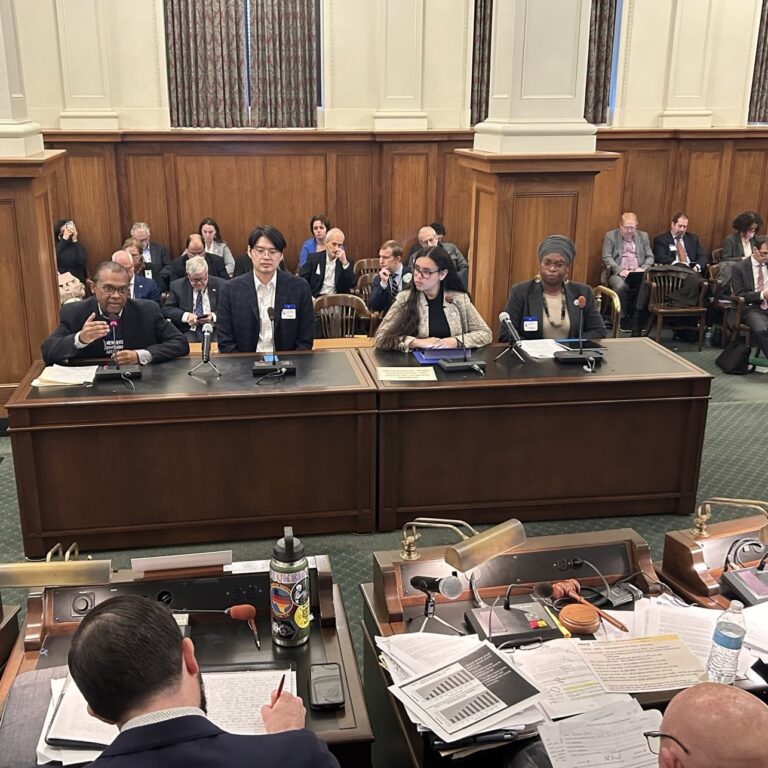
On March 11, 2024, the New Jersey Environmental Justice Alliance (NJEJA) went to Trenton to once again testify on the Clean Energy Standard. 

NJEJA testified in a joint hearing before the Senate Energy and Environment Committee and the Assembly Telecommunications and Utilities Committee on the proposed Clean Energy Standard (SB237/AB1480) alongside the Ironbound Community Corporation, Earthjustice, and NJPEEC, all of whom were invited to testify and represent the Environmental Justice perspective.

If passed, the legislation would set a clean energy definition that would require that 100% of the energy purchased in the state must be generated by clean sources by 2035. This bill has the potential to affect New Jersey residents for decades to come and determine whether or not the state can reach Governor Murphy’s clean energy goals. NJEJA previously testified on this bill back in November 2023, but it did not pass during the lame duck session and was reintroduced under new bill numbers at the start of the new legislative session.

Brooke Helmick testified on behalf of NJEJA, highlighting that this definition has the potential to be a nation-leading moment for the state, but only if legislators are intentional and technical with their definition, ensuring that any facilities labeled ‘clean’ produce as close to zero pollution as possible, facilities aren’t allowed to engage in offsets which displace pollution from one community to another, and the definition is intentional to address harmful, dangerous co-pollutants in addition to greenhouse gases. She brought particular attention to the dangers of toxic air pollutants, such as PM 2.5 and NOx, which are harmful to physical health and lead to a number of negative physical health outcomes. 

NJEJA closed their testimony by highlighting that this bill focuses on energy purchased for the state, but not necessarily energy produced in the state. However, given that one bill can’t do everything, NJEJA closed by highlighting for the committees that they looked forward to coming back to Trenton to discuss a complement to this bill which would address pollution at facilities that produce energy in the state.  

Read NJEJA’s press release.

Comments to the Dept. of Treasury on Credits for Hydrogen Production

To date, climate change mitigation policy has typically been carbon-centric and focused solely on reducing carbon emissions. We urge the 45(v) tax credit proposed rule to move away from carbon centrism by addressing EJ issues that include limiting the emissions of GHG co-pollutants in general as much as possible.

A carbon centric approach and focus on solely using the lifecycle GHG emissions rate of hydrogen production as the metric to determine whether the hydrogen produced is “clean”, is a significant EJ concern. This approach ignores the emissions of GHG co-pollutants along the life cycle of not just hydrogen production but storage, delivery and end uses (such as the burning of hydrogen-blended natural gas at power plants3). Additionally, when a life cycle GHG emissions rate is the sole metric to determine whether the hydrogen produced is clean, a myriad of environmental and health impacts along the hydrogen production chain remain insufficiently addressed.

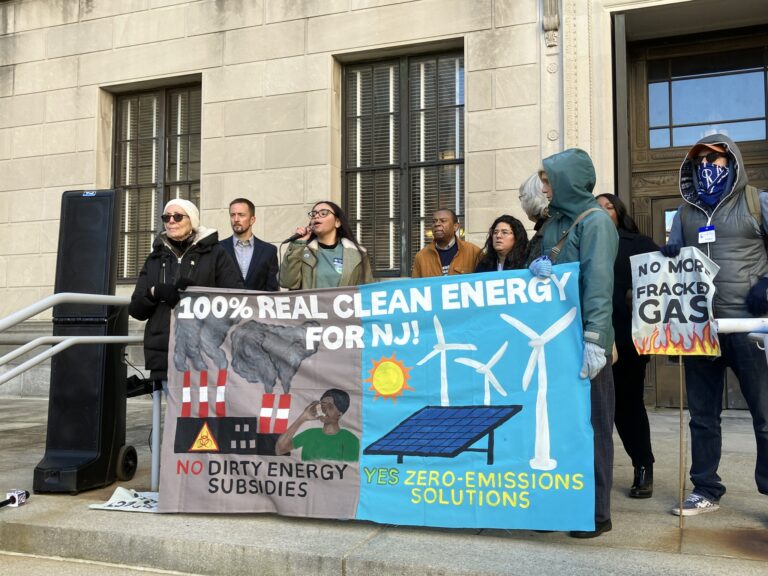
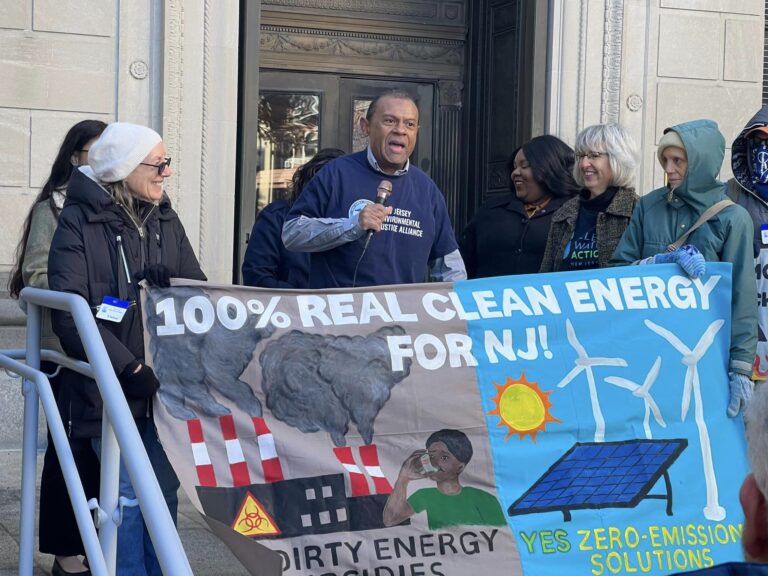
Environmental Justice Advocates Rally in Trenton to Push for Real Clean Energy Policy

On November 20, 2023, the New Jersey Environmental Justice Alliance (NJEJA), alongside partner organizations including Ironbound Community Corporation and Clean Water Action, joined forces to rally and testify in Trenton. The focus of our advocacy was Senate Bill S2928, a crucial piece of legislation aimed at achieving 100 percent clean electricity by 2035. However, NJEJA urged for a critical amendment to the definition of “clean” energy, excluding sources that contribute to greenhouse gas emissions and toxic co-pollutants like NOx.

Trash incineration, hydrogen combustion, and flawed ‘carbon capture’ technologies are among the sources we sought to exclude from the clean energy definition. The rally and testimonies were integral to emphasize the importance of addressing harmful co-pollutants in climate change mitigation policy and recognizing the need to safeguard overburdened communities through robust legislation.

Melissa Miles, Brooke Helmick, Thomas Ikeda, and Dr. Nicky Sheets passionately testified on behalf of NJEJA, underscoring the urgency of prioritizing public health and environmental justice in clean energy policies. Dozens of environmental justice and climate activists participated in the rally, echoing the call for strong clean energy policies. The collective goal is to combat climate change, protect public health, and promote environmental justice. Activists also voiced their opposition to provisions in the bill that could impede the state’s transition to genuinely clean, non-polluting energy technologies, potentially tethering New Jersey to outdated and polluting fossil fuel practices.

“We want as close to zero emissions as possible,” stated Melissa Miles, Executive Director of the New Jersey Environmental Justice Alliance, during her testimony. She also criticized a provision in the bill that permits facilities to purchase clean-electricity credits to offset emissions in overburdened communities, emphasizing the need for comprehensive and immediate action to achieve meaningful environmental progress.